
Why Designers Choose Kashmir Sapphires (And How to Source Them)
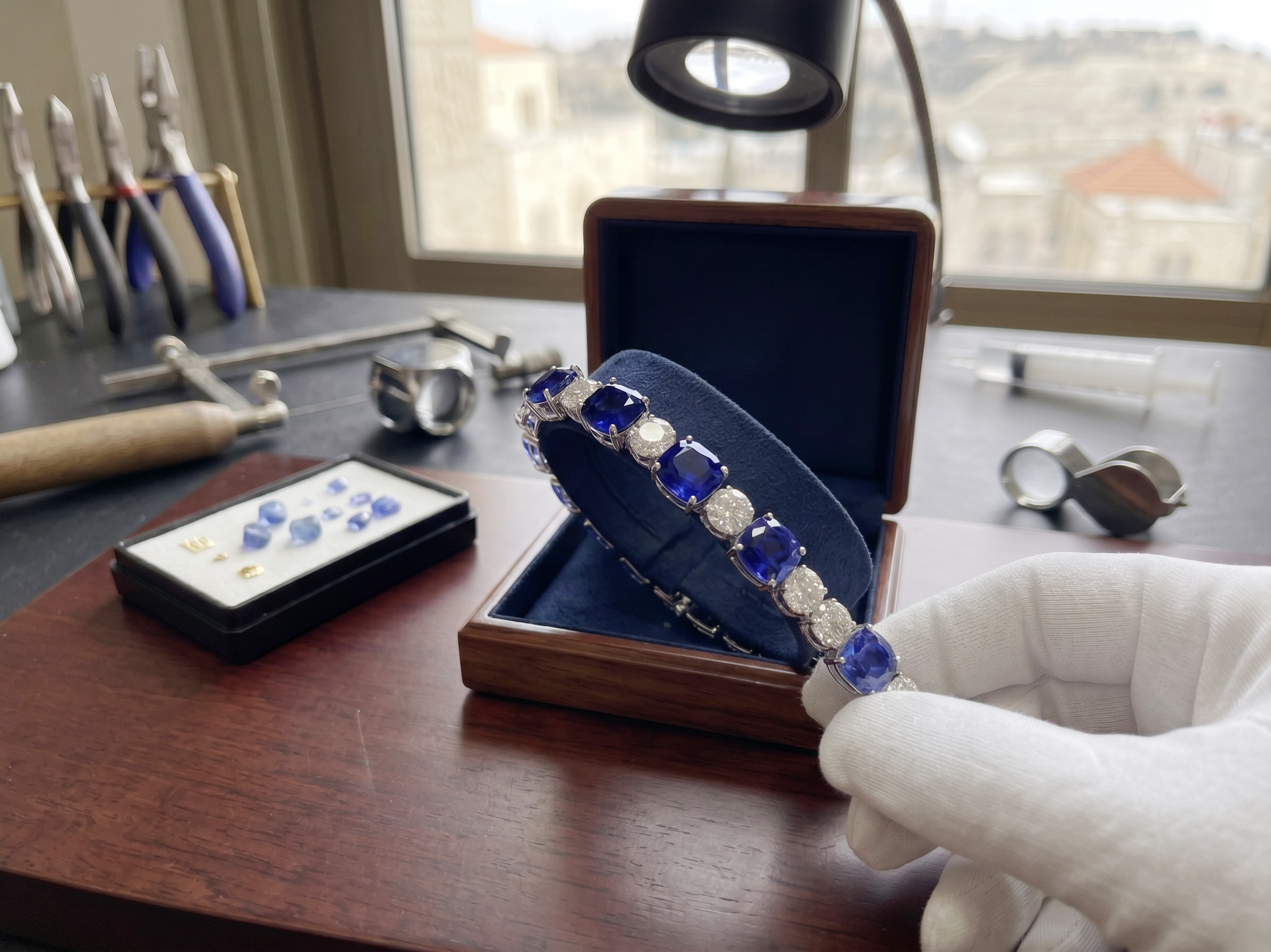
A Kashmir sapphire and diamond bracelet in platinum — cushion-cut sapphires displaying the characteristic velvety cornflower blue that no other origin replicates. Rough Kashmir crystals visible in the tray to the left. Fine Kashmir material at this level is sourced from the secondary market, not from active mining — every stone in a piece like this has been circulating since the late 19th century.
In the sapphire world, Kashmir is the name that ends the conversation. Not because it's the most available — it is almost certainly the least available of any major sapphire origin — but because it represents a standard of color and quality that the market has elevated above all others for over a century. For jewelers and designers working at the top of the colored stone market, understanding Kashmir sapphire is not optional. It is the benchmark.
What Makes Kashmir Different
Kashmir sapphires come from a single high-altitude deposit in the Zanskar range of the Himalayas, discovered in the late 1870s after a landslide exposed the deposit. Mining was active for only a few decades before the primary deposit was exhausted. The sapphires that emerged during that period established the Kashmir standard — a color so distinctive that gemologists still describe it as the reference point for all sapphires.
That color is described as a velvety, cornflower blue — a slightly violet-blue of extraordinary saturation that appears to shift subtly in different lighting conditions. The velvety quality is not metaphorical: it is caused by the presence of fine rutile needles within the stone that scatter light slightly, softening the color and giving it a depth that faceted stones from other origins rarely achieve. This is the quality that distinguishes Kashmir from Ceylon, Madagascar, and other fine blue sapphire origins — not just the color, but the way the color lives in the stone.
Geologically, Kashmir sapphires contain relatively low iron, which contributes to their strong blue saturation without the darkening effect that higher iron content produces in sapphires from other origins. The combination of low iron, strong chromium and vanadium content, and the particular geology of the Himalayan deposit created a sapphire type that has never been fully replicated.
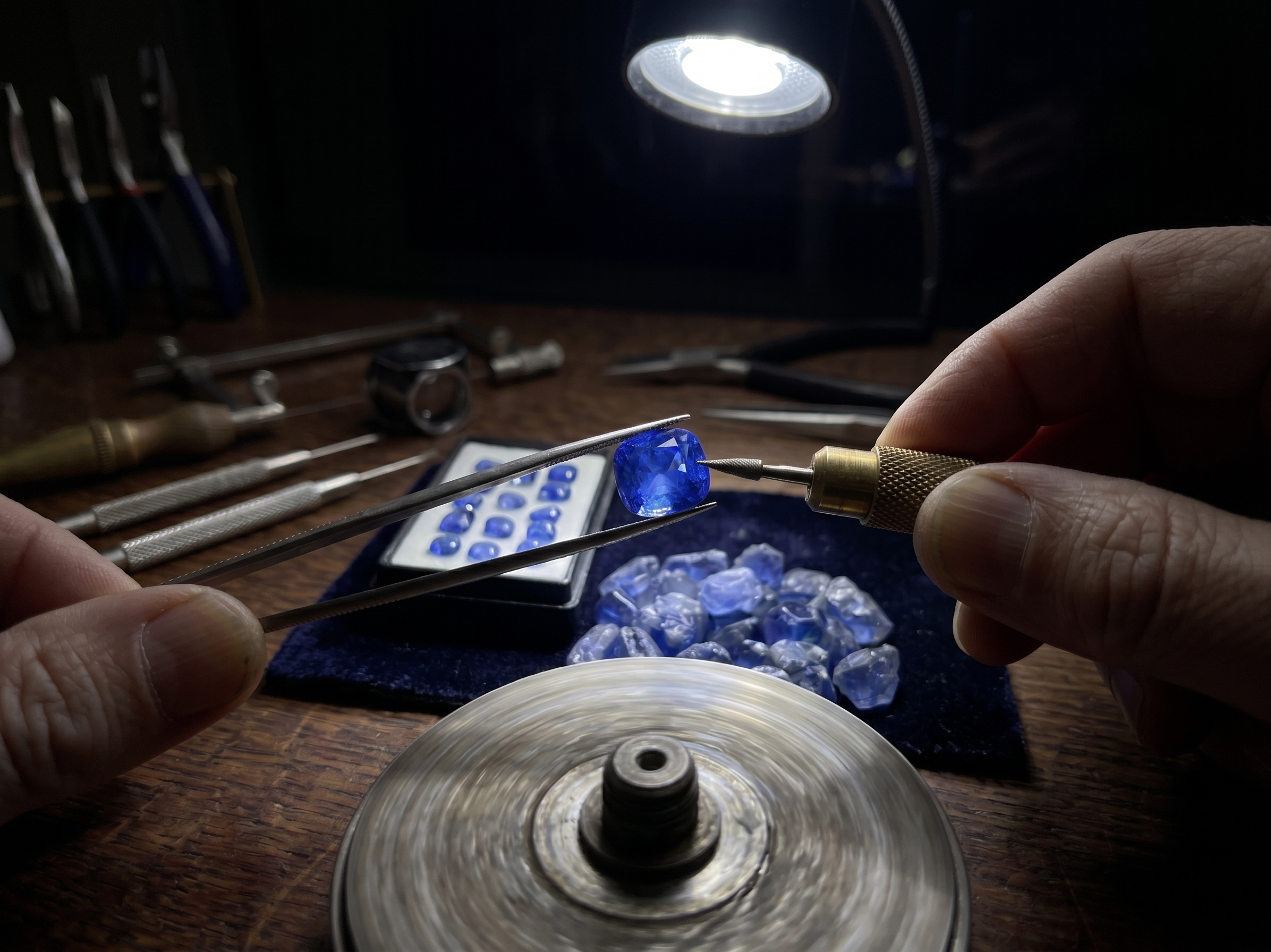
A Kashmir sapphire being brought to its final cut — rough crystals in the background, the spinning lap in the foreground. Every Kashmir sapphire on the market today is antique or estate material; none comes directly from active mining. What the lapidary works with now is a finite, irreplaceable supply that has been circulating since the late 19th century.
The Supply Reality
Understanding Kashmir sapphire begins with understanding supply. The primary deposit is exhausted. No significant new mining has occurred in decades. Every Kashmir sapphire on the market today is antique or estate material — a stone that was mined over a century ago and has been circulating through the market since.
This means that Kashmir sapphire is not sourced from a mine — it is sourced from the secondary market: auctions, estate collections, private transactions, and established dealers with long-term relationships in the trade. The pool of available stones is finite and shrinking as stones are set, held in collections, or removed from active circulation.
For jewelers and designers, this supply reality shapes every aspect of the sourcing conversation. Kashmir sapphires are not ordered — they are found. And finding them requires either auction access, relationships with dealers who specialize in this category, or both.
Laboratory Confirmation: Non-Negotiable
At the price points Kashmir sapphires command, laboratory origin confirmation is not a preference — it is a requirement. GIA, Gübelin, SSEF, and GRS all issue Kashmir origin opinions, and a fine Kashmir sapphire without a laboratory report is essentially unsaleable at full value to any informed buyer.
The laboratory process for Kashmir involves spectrographic analysis, inclusion mapping, and comparison with a reference database of confirmed Kashmir material. The report will confirm or not confirm Kashmir origin, note treatment status (Kashmir sapphires are typically unheated, and that status adds significantly to value), and provide a quality assessment.
For jewelers presenting Kashmir sapphires to clients, the laboratory report is part of the story. It is the documentation that transforms a blue stone into a Kashmir sapphire — with all the history, rarity, and price premium that designation carries.
Why Designers Are Drawn to Kashmir
For designers working at the top of the luxury market, Kashmir sapphires offer something that few other stones can: a combination of extraordinary color, historical significance, and a rarity that clients immediately understand. A Kashmir sapphire is not just a beautiful blue stone — it is a specific, documentable, irreplaceable object.
The color also works exceptionally well across design contexts. The velvety quality that distinguishes Kashmir means the stone reads beautifully in both high-light and low-light settings, holds its color across metal types, and photographs in a way that captures the depth rather than flattening it. For designers who have worked with fine Ceylon and Madagascar sapphires, a Kashmir stone in hand is immediately recognizable as different — not always dramatically, but in a quality of presence that experienced eyes distinguish quickly.
Designers who work with Kashmir tend to design around the stone rather than selecting the stone for the design — which is the mark of a truly significant material.
The Sourcing Conversation
For jewelers looking to offer Kashmir sapphires to clients, the conversation begins with a realistic inventory: fine Kashmir sapphires are available in the market, but not on demand. Building access to this category means establishing relationships with dealers who handle serious estate and antique colored stones, monitoring major auction results to understand current market pricing, and being prepared to move when fine material becomes available rather than waiting for a client commission.
Price points range widely based on size, color, and clarity, but fine Kashmir sapphires — particularly those in the two-to-five carat range with strong color and clean laboratory reports — consistently achieve prices that reflect their scarcity and prestige. At the top of the market, Kashmir sapphires over five carats with exceptional color command prices that rival the finest rubies and emeralds.
For jewelers who serve clients at this level, having access to Kashmir material — even occasionally — is a meaningful differentiator. It positions the jeweler as someone who operates in the same market as the stones themselves: rare, expert, and worth the relationship.
Looking for Kashmir Sapphires?
Jacoby Gems works with jewelers and designers to source Kashmir sapphires with full laboratory documentation including origin confirmation and treatment status. Fine Kashmir material is not always available, but when it is, having the right dealer relationship makes all the difference.
