
What Jewelers Need to Know About Burmese Rubies
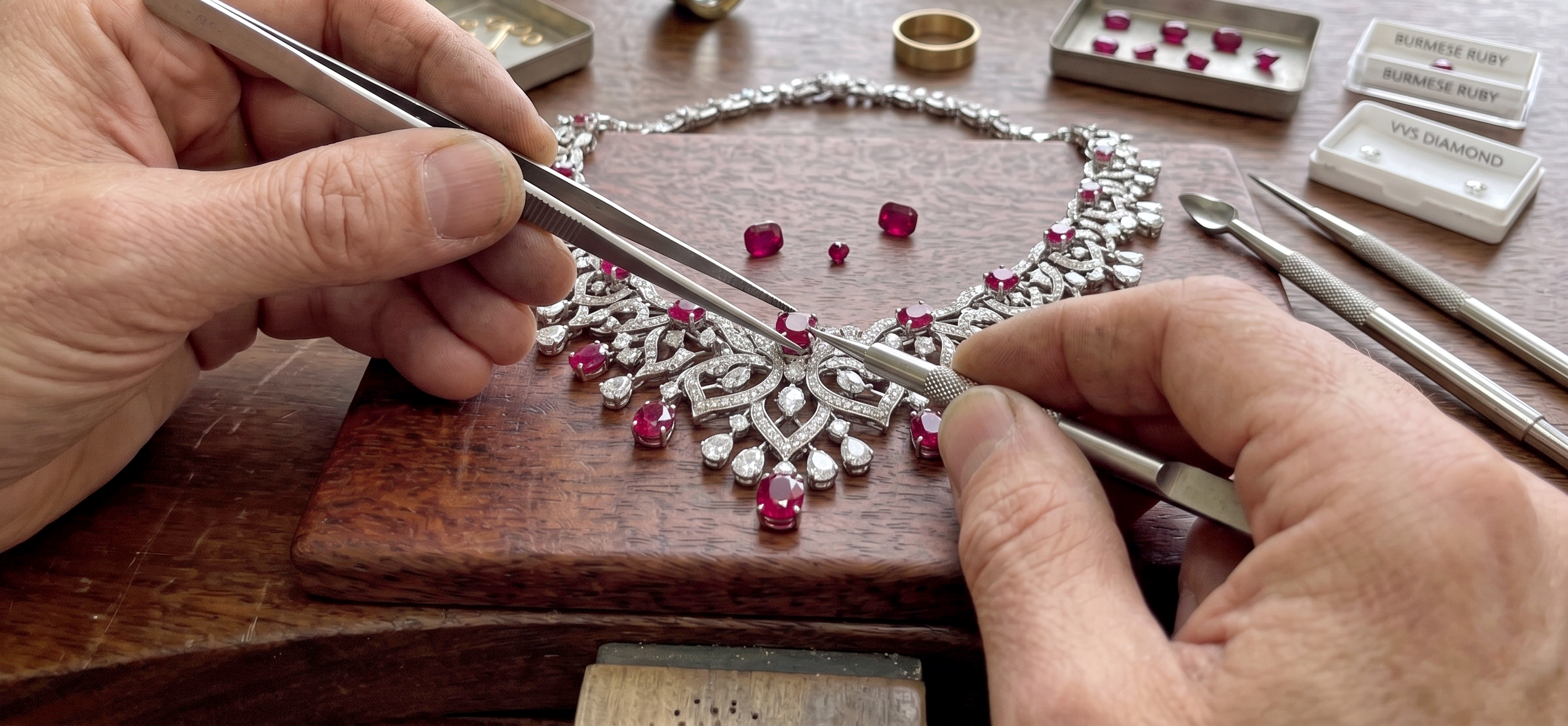
Burmese rubies being set into a diamond necklace — fine Mogok material in the hands of a trade jeweler. The labeled specimen trays in the background reflect the documentation standards that distinguish serious ruby sourcing from commercial grade purchasing.
No gemstone carries more prestige in the colored stone market than a fine Burmese ruby. Among trade professionals, the phrase "Burmese ruby" isn't just a geographic designation — it's shorthand for the highest standard of color, saturation, and origin in the ruby world. For jewelers who work with discerning clients, understanding what makes Burmese material exceptional — and what to look for when sourcing it — is essential knowledge.
This guide covers the key quality factors, the significance of origin, treatment standards, and what the Burmese ruby market looks like for trade buyers today.
Why Burma?
The Mogok Valley in Myanmar (historically Burma) has been the world's most celebrated ruby source for centuries. The geology of Mogok produces rubies with a combination of characteristics that other origins struggle to replicate: a vivid, pure red color with strong fluorescence under UV light, relatively high clarity for the ruby category, and a saturation that gemologists describe as internally lit.
The fluorescence is a critical factor often overlooked in casual discussion. Burmese rubies contain relatively low iron, which allows their chromium content to fluoresce strongly under both UV and natural daylight. The result is a stone that appears to glow — that quality sometimes described as "pigeon blood" at its finest. Rubies from most other origins contain more iron, which suppresses fluorescence and produces a darker, less luminous appearance even at comparable saturation levels.
This is why Burmese origin matters so much to sophisticated buyers, and why laboratory origin reports have become standard documentation for fine rubies.
Pigeon Blood: What It Actually Means
Pigeon blood is the most used — and most misused — term in the ruby market. Technically, it refers to a very specific color: a pure, vivid red with a slightly bluish secondary hue, at high saturation, with strong fluorescence. The term originated in the Mogok trade to describe the finest material — the color of the first drop of blood from a freshly killed pigeon, which has a particular purity and brightness.
In contemporary trade, "pigeon blood" is often applied loosely to any fine red ruby. For jewelers working at the top of the market, it's worth understanding the distinction: true pigeon blood designation requires laboratory confirmation (GRS, GIA, Gübelin, and SSEF all issue pigeon blood quality opinions), and that designation carries a significant price premium.
For clients who want the designation, insist on laboratory documentation. For clients who want the visual quality without the premium, a fine undesignated Burmese ruby can offer excellent value.
Heat Treatment: The Standard and the Exception
The great majority of rubies on the market are heat treated. Heat treatment improves color and clarity by dissolving rutile silk (which causes haziness) and optimizing the chromium absorption that produces red color. For ruby, heat treatment is industry-standard, widely accepted, and does not carry the stigma it might in other stone categories.
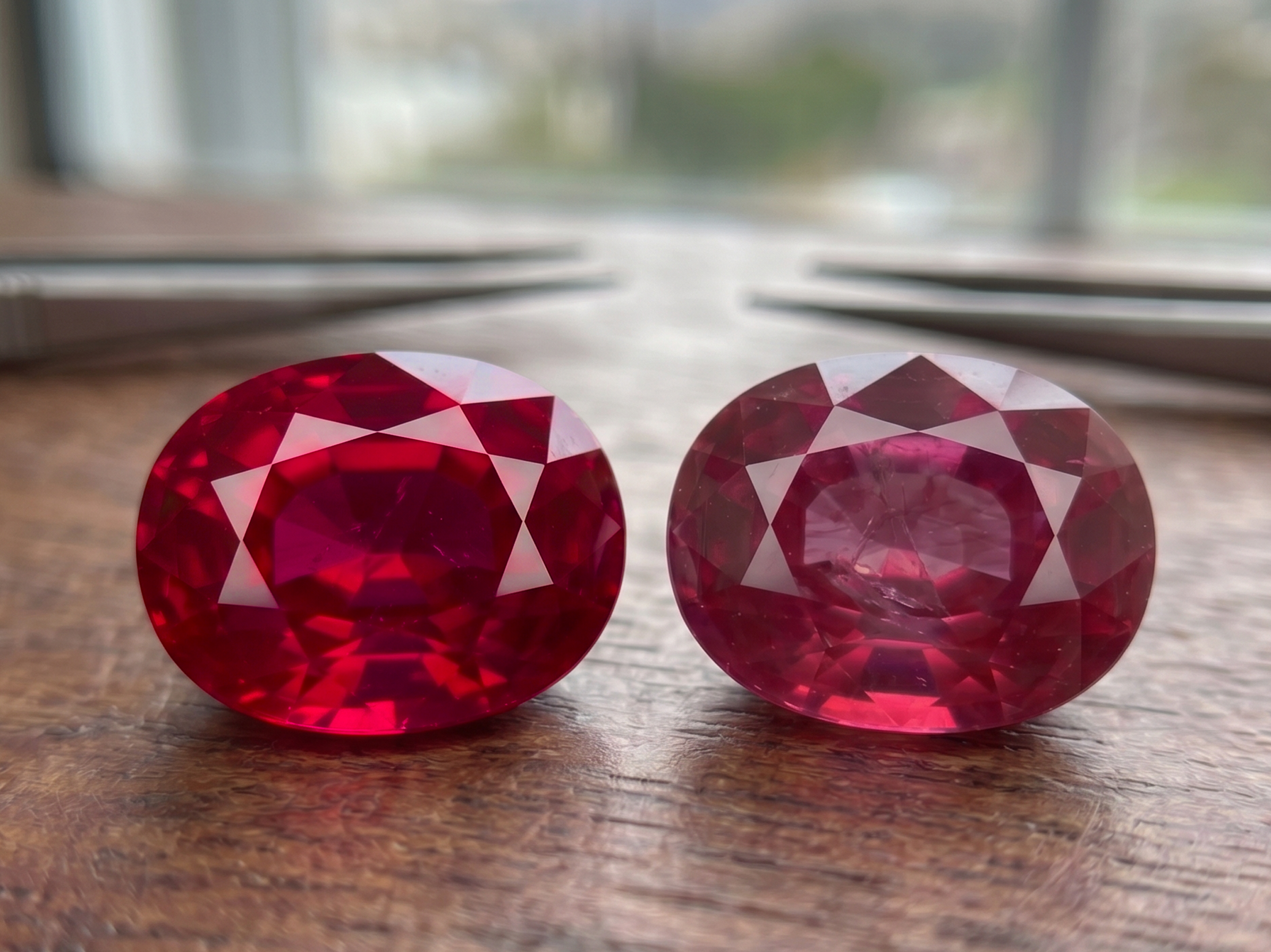
Pigeon blood ruby (left) versus lower-grade Burmese ruby (right). The difference is in color purity and saturation — the pigeon blood stone displays a vivid, pure red with depth and no pink or brown modifier. True pigeon blood designation requires laboratory confirmation from GRS, GIA, Gübelin, or SSEF and carries a significant price premium over undesignated material.
What matters is full disclosure and laboratory documentation of treatment status. A heated Burmese ruby with a clean origin report and good color is a legitimate, valuable stone. An unheated Burmese ruby of comparable quality commands a meaningful premium — sometimes 30–50% or more over equivalent heated material — because unheated stones at fine quality are genuinely rare.
For jewelers, the practical guidance is straightforward: always know the treatment status of what you are selling, always disclose it to clients, and always have documentation for significant stones. Clients who understand the market will ask, and those who don't will trust you more for having volunteered the information.
Clarity Expectations
Ruby is a Type II gemstone, meaning inclusions are expected and accepted in a way they would not be for, say, aquamarine or blue topaz. The ruby market grades clarity relative to the category: an eye-clean ruby is exceptional, a stone with minor inclusions visible to the naked eye is common, and significant inclusions that affect transparency or durability reduce value substantially.
Burmese rubies often contain needle-like rutile inclusions (silk), growth patterns, and fingerprint inclusions. Some of these — particularly fine silk that creates a velvety appearance — can actually enhance the stone's visual appeal by softening the color. A stone with heavy silk that reduces transparency is a different matter.
For jewelers presenting rubies to clients, the clarity conversation is about context: explaining that inclusions are normal and expected in this category, while pointing out what specifically distinguishes a fine stone from a commercial one.
The Market Today
Burmese ruby supply has been complicated by sanctions, export restrictions, and the political situation in Myanmar. Stones that were mined and exported before the most recent sanctions periods are freely tradeable with proper documentation; new production is subject to restrictions in some markets. For U.S.-based jewelers, understanding the current legal landscape around Burmese ruby import is important due diligence.
The supply constraint has driven prices upward for fine material with clear provenance. Laboratory reports that establish both Burmese origin and pre-sanctions export history have become more significant as documentation.
Despite the complications, fine Burmese ruby remains the benchmark of the colored stone world — the stone that other rubies are measured against, and the one that serious collectors and clients consistently seek. For jewelers who can source it well, it remains among the most rewarding stones to work with.
Working with a Trusted Dealer
The Burmese ruby market rewards relationships. Fine material at the level where origin and treatment documentation matter is not available through standard wholesale channels — it moves through networks built on expertise and trust. A dealer who has handled significant Burmese material over decades, who understands the distinction between pigeon blood quality and commercial fine, and who can provide and explain laboratory documentation is the starting point for sourcing this category well.
For jewelers entering this market or expanding their colored stone offering, that relationship is the asset.
Looking for Fine Burmese Rubies?
Jacoby Gems works with jewelers and designers to source natural Burmese rubies with full gemological documentation, including origin reports and treatment disclosure. Whether you're looking for pigeon blood quality or fine undesignated material, we're happy to discuss what's available.
