
Why Jewelry Designers and Manufacturers Choose Local Gem Dealers vs. Overseas Suppliers
Custom Cuts, Rare Stones, No Minimums — and a Supplier Who Actually Picks Up the Phone
If you've spent any time sourcing gemstones online or through overseas wholesalers, you already know the experience. You order a parcel of stones based on a photo, wait weeks for delivery, and open the package to find colors that looked nothing like the listing, sizes that don't quite match your design specs, and no one to call when something is wrong. You absorb the loss, move on, and do it again next season.
This is the baseline experience for a significant portion of the jewelry design and manufacturing industry — and it doesn't have to be. The alternative isn't more careful overseas shopping. It's working with a local gem dealer who has spent decades building the kind of inventory, relationships, and expertise that no overseas platform can replicate.
Here is what that difference actually looks like in practice.
You Can See the Stone Before You Buy It
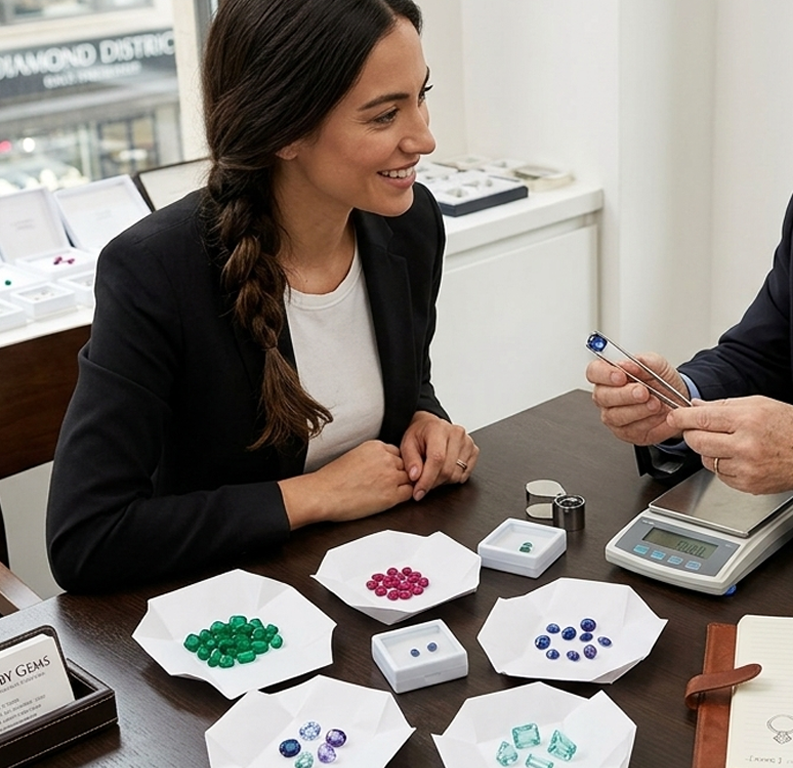
A jewelry designer reviewing parcels of loose stones directly with a dealer at the Diamond District — emeralds, rubies, sapphires, and tanzanites laid out for comparison. This is the sourcing experience that no overseas platform can replicate.
This sounds obvious. It shouldn't have to be a selling point. But for anyone who has sourced stones through overseas suppliers, it is. A photograph — even a good one — cannot tell you how a stone behaves in light, how its color shifts between daylight and incandescent, or whether the clarity is acceptable for your intended setting. A video gets closer, but it still isn't the stone in your hand.
Working with a local gem dealer in a market like the New York Diamond District means you can examine stones directly, compare them side by side, and make a decision based on the actual material — not a representation of it. For designers whose work depends on a specific color, cut, or visual quality, this is not a minor convenience. It is the difference between a stone that works and one that doesn't.
No Minimums. No Bulk Commitment.
Overseas wholesale typically comes with volume requirements. If you're an independent designer or a manufacturer running smaller production runs, those minimums are a real barrier. You end up ordering more than you need, tying up capital in inventory, or compromising your design because you can't source a single stone at a reasonable price.
A local dealer operates differently. There are no minimum order requirements. You can source one stone for a one-of-a-kind commission. You can order a small parcel for a limited run. You can test a new stone type before committing to it across a collection. That flexibility matters enormously for designers and manufacturers who work at the scale of craft rather than mass production.
Custom Cuts and Made-to-Order Work
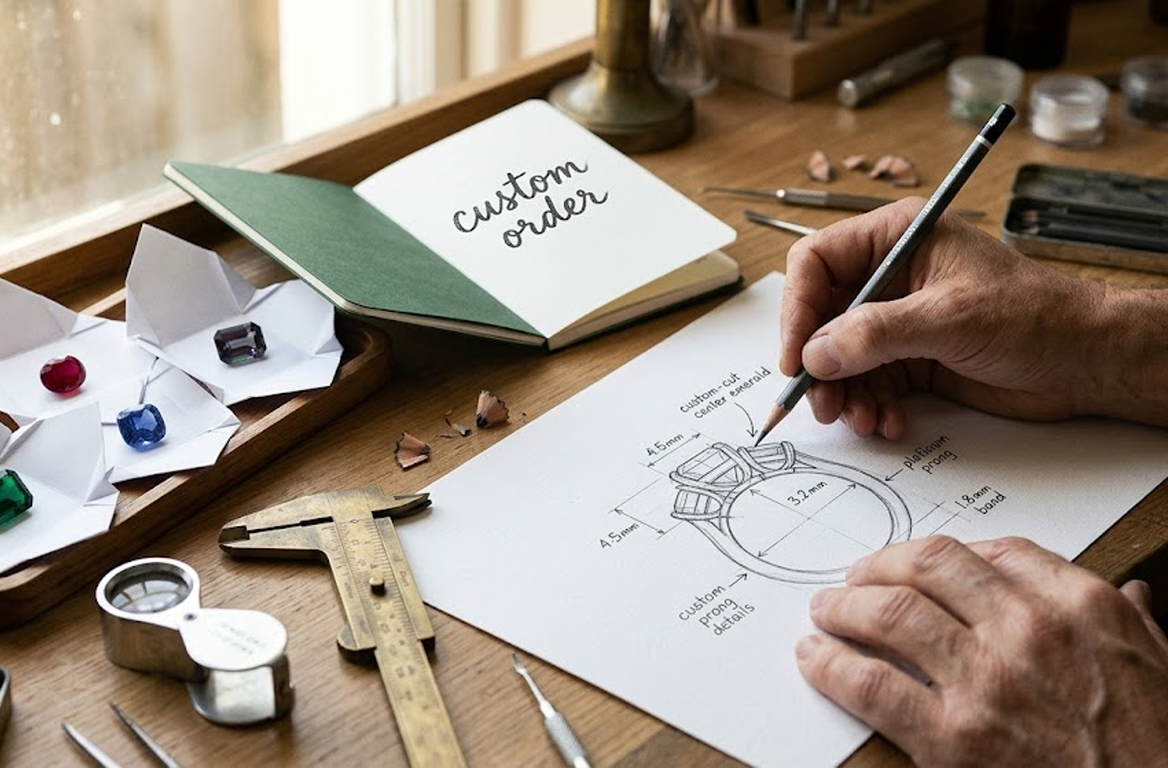
A custom commission in progress — ring sketch with precise measurements alongside loose colored stones in paper parcels. Emerald, ruby, sapphire, and alexandrite, each a candidate for the center stone. This is the made-to-order work that separates a local gem dealer from an overseas platform.
This is where the gap between a local dealer and an overseas supplier becomes most visible. Overseas platforms sell what they have. Jacoby Gems can get you what you need.
Custom cutting — calibrated sizes, unusual shapes, specific proportions for a particular setting — is standard territory for a dealer with the right connections. So is sourcing a stone type that doesn't appear in any catalog: a specific alexandrite with strong color change in both directions, a Kashmir sapphire for an estate-level commission, a large parcel of matched tourmalines for a production run.
The made-to-order capability extends beyond conventional jewelry. Abraham Jacobowitz of Jacoby Gems — with over thirty years in the colored stone trade — has executed commissions that go well beyond standard design work. Asked once to supply a custom perfume bottle stopper in lapis lazuli, cut and polished to precise specifications, he delivered. That example illustrates something important: when a client has a vision, the question isn't whether it can be done. It's who has the expertise and the connections to do it.
"If someone comes to me with a sketch or a specific idea, I want to figure out how to make it happen.
That's the part of this business I enjoy the most — when a designer has a vision and we can actually build it together."
— Abraham Jacobowitz, Jacoby Gems
Natural, Lab-Grown, and Synthetic: Full-Spectrum Sourcing
The conversation about natural versus lab-grown stones has shifted significantly in the past decade. Lab-grown diamonds and colored stones have become serious commercial material — not a compromise, but a deliberate choice for designers who need consistent color, reliable supply, and accessible price points for certain parts of their line.
A knowledgeable local dealer works across the full spectrum with genuine expertise in each category. Natural stones — rubies, sapphires, emeralds, alexandrites, and more — for clients who want provenance, rarity, and the real thing. Lab-grown colored stones for designers building collections where color consistency and value matter. High-quality cubic zirconia and moissanite for sample work, fashion jewelry, design prototyping, and fashion-forward collections where brilliance and value matter more than natural origin.
Jacoby Gems has deep experience in both the natural colored stone market and the lab-grown and synthetic space, and approaches both with the same standard: quality, accuracy, and full transparency about what you're buying.
The Overseas Market Has a Fraud Problem
This is a topic the trade discusses quietly and buyers learn about the hard way. The overseas gem market — particularly through e-commerce platforms — has a well-documented problem with misrepresentation. Synthetic stones sold as natural. Heated material sold as untreated. Color-enhanced stones with no disclosure. Weights and grades that don't match what arrives.
The problem isn't that all overseas suppliers are dishonest. Many are legitimate. The problem is that at distance, with no relationship and no recourse, it is very difficult to distinguish between them — until after the money has changed hands and the package has arrived. A local dealer operates under a completely different accountability structure. Their reputation is built over decades of face-to-face transactions. They stand behind what they sell. If something is wrong, you can walk back in and have a conversation.
A Relationship That Grows With Your Business
The most undervalued aspect of working with a local dealer is what the relationship becomes over time. A dealer who knows your work, your clients, your aesthetic sensibility, and your price points can source for you proactively — alerting you to material that fits your line before it moves to someone else, setting aside stones that match an ongoing need, advising on what's happening in the market that might affect your sourcing.
That kind of supply relationship isn't available through a platform. It comes from working consistently with someone who has a genuine stake in your success.
Ready to Source Differently?
Tell us what you're looking for — stone type, size, color, budget. We'll source the options, photograph them, and send them to you directly. No commitment, no invoice, nothing until you say yes.
And we'll ship your first order at no cost.
This is how Jacoby Gems works with every new client.
Call Abraham at 718.435.0289 or send your spec to jacobygems.com/contact.
